

The collapse of Kurdish Rojava
Are we about to see the end of Kurdish autonomy in Syria?

Background
The Kurds are a minority ethnic group in Syria, making up approximately 10% of the total population and are located primarily along the northern border with Türkiye.
Kurdish majority areas are spread across Türkiye, Syria, Armenia, Iraq, and Iran. They have long been an oppressed group suffering notably under the regimes of the Assads in Syria and Saddam Hussein in Iraq. Both regimes followed Arabisation doctrines across the Kurdish-majority regions. These actions, rather than homogenising the respective countries, further drove divisions and fuelled the desire by the Kurdish people to have autonomy.
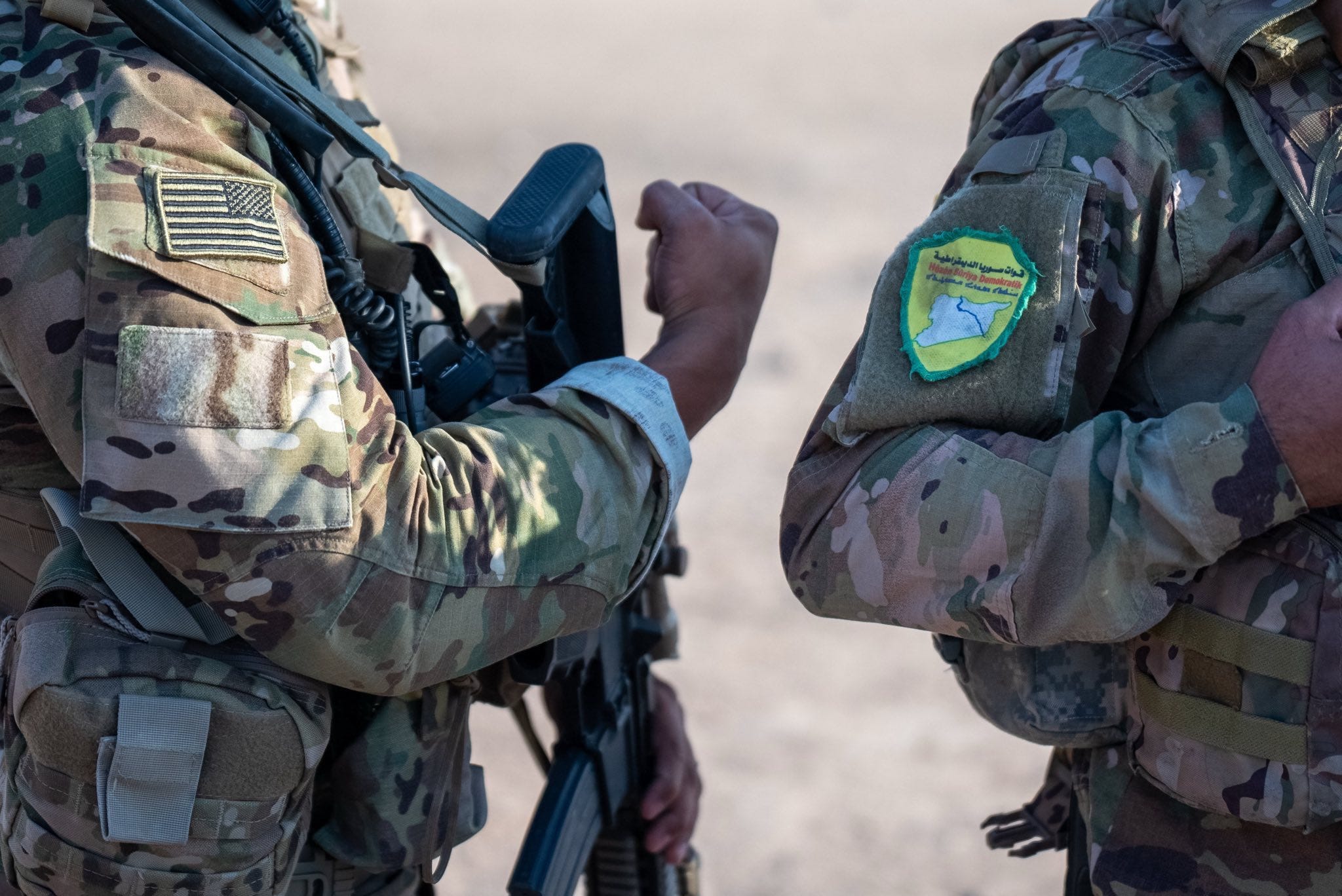
When the Syrian civil war began in 2011, local Kurdish militias rose to fill the security gap when the Syrian army redeployed to counter the Syrian opposition forces. The Kurdish people then created administrative committees to manage the areas under their control. These evolved into the Democratic Autonomous Administration of North and East Syria (DAANES), more commonly known as Rojava. The official military wing of Rojava is the SDF (Syrian Democratic Forces), a collection of Kurdish militia groups.
The SDF rose to prominence due to its fight against ISIL / ISIS, which had captured large swathes of Syria by 2014. The US campaign against ISIS led to American support for the SDF through equipment and airstrike coordination. By the time ISIS was effectively defeated in Syria, the SDF had vastly expanded its control of Northern Syria, controlling almost all areas North of the Euphrates.
In 2019, Türkiye carried out an offensive in SDF-controlled areas of Northern Syria, establishing a buffer zone. Türkiye strongly opposes the establishment of a Kurdish state due to its internal conflict against its own significant Kurdish minority in the East of the country.
Recent situation
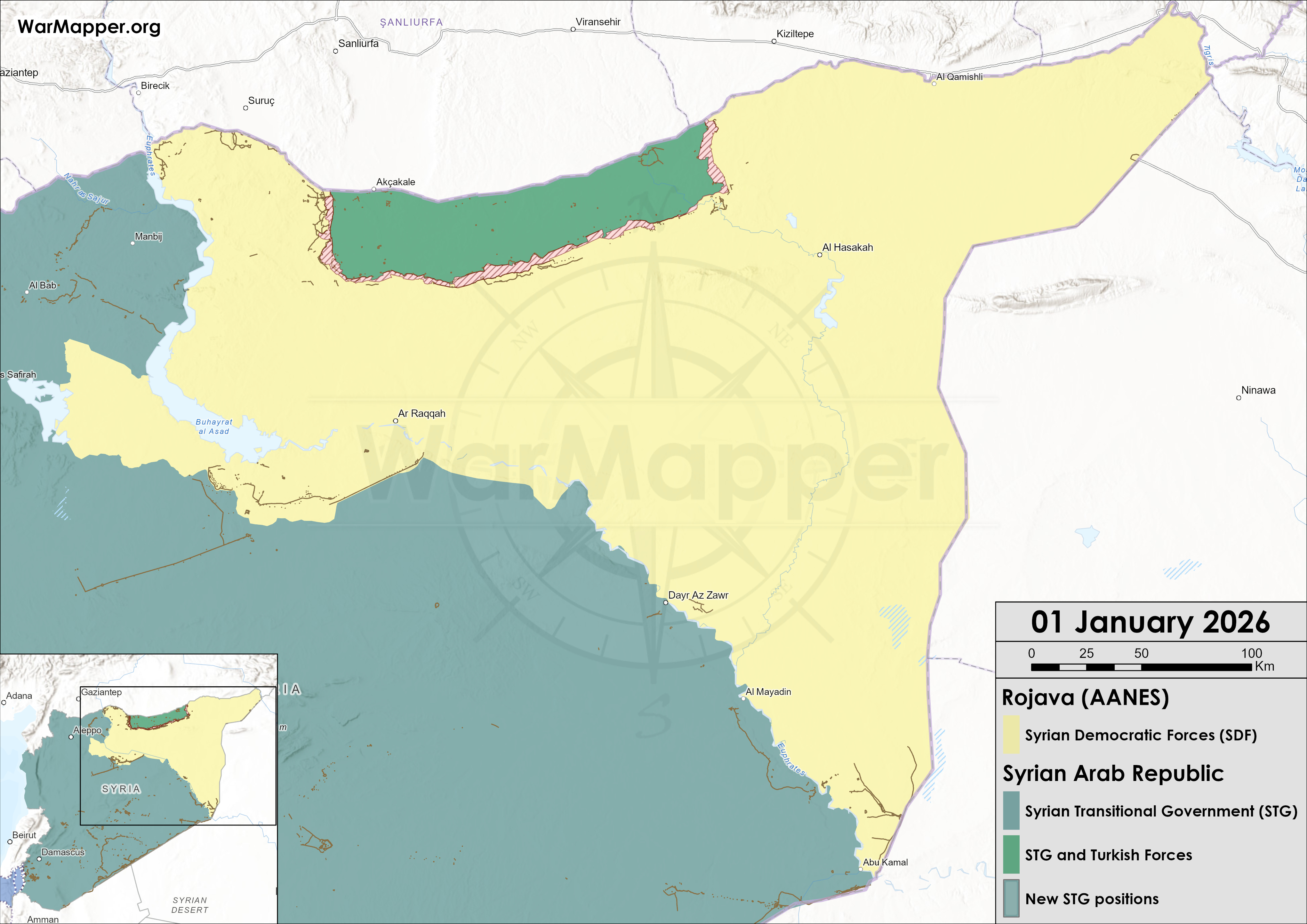
After the fall of Assad in late 2024, Kurdish forces initially took control of areas on the southern bank of the river. They soon lost territories west of the Teshren Dam to the Syrian National Army (SNA). The SNA was the armed wing of the Turkish-backed Syrian Interim Government (SIG), which merged with Hay’at Tahrir Al-Sham (HTS) into the Syrian Transitional Government (STG).
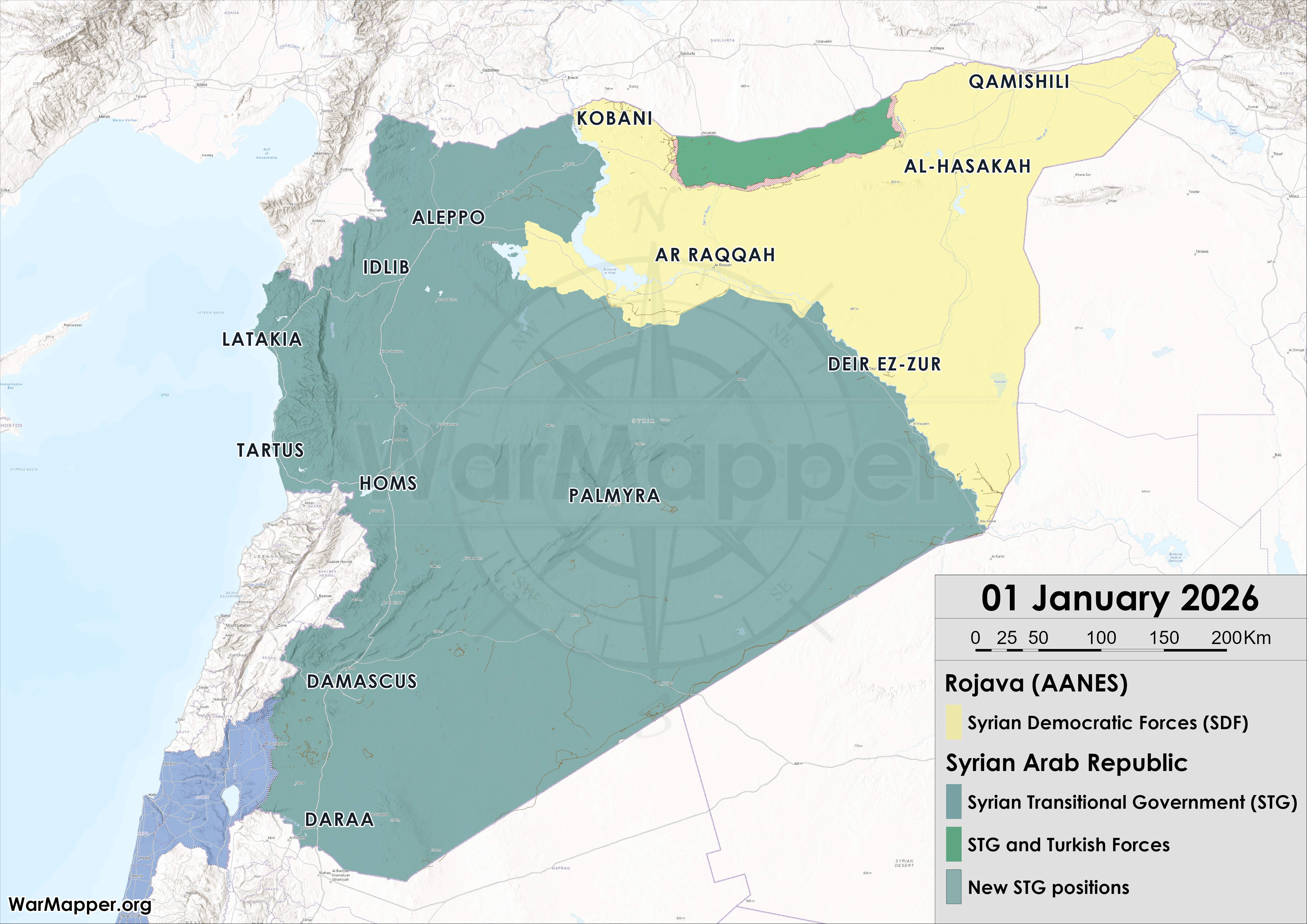
Due to the expansion out of the Kurdish majority regions into formerly ISIS-controlled areas, the majority of the cities, towns, and villages that the Kurds controlled are populated by Arabs. While the SDF has presented itself as a multi ethnic democratic force under DAANES, many Arab communities view it as primarily serving Kurdish political ambitions. This has led to animosity among some of the Arab population living under their rule, including local allied Arab militias.
Since the STG was formed, Syria has largely been split into two: the new Syrian government and the SDF. Negotiations were ongoing for integrating Kurdish-controlled areas into the new government. Negotiations over integration stalled, and tensions over control, representation, and security soon escalated into open conflict.
Fighting restarts
Earlier this month, after clashes in Aleppo, the STG advanced into and took full control of the Sheikh Maqsood neighbourhood. The SDF then also withdrew from territories on the southern bank of the Euphrates. The neighbourhood of Sheikh Maqsood had long been held by Kurdish forces, with the rest of the city controlled initially by the Assad regime, and then the STG since the end of 2024.
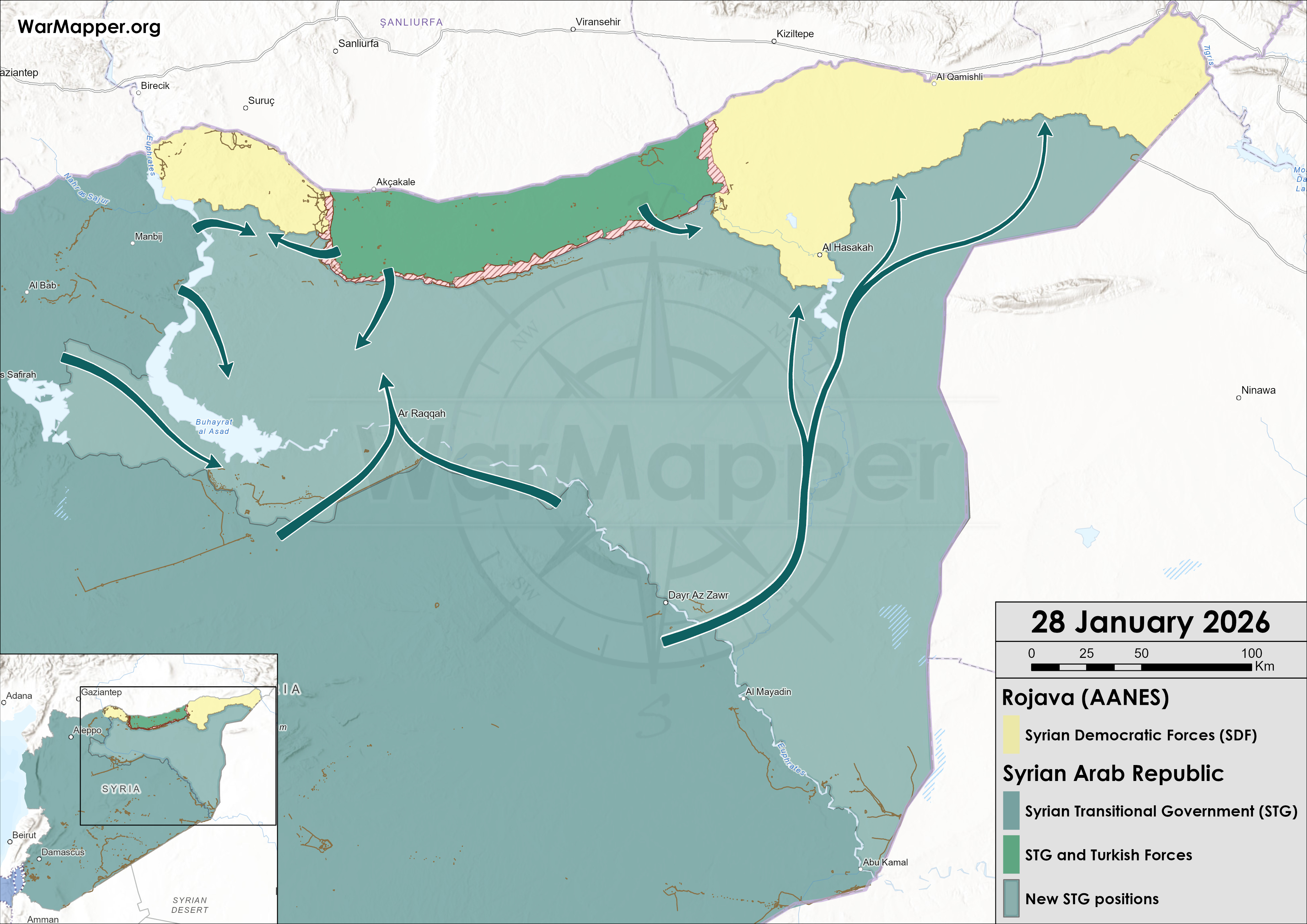
On the 13th, the STG began to advance into SDF territory. Arab armed groups and former SDF allies within the DAANES took advantage of the advance and rose up, seizing towns and cities ahead of the Syrian Army’s advance.
The advancing STG met with forces in the former Northern Syria Buffer Zone. In less than a week, the SDF had largely been forced back to controlling only the Kurdish majority areas of their former territory.
On the evening of Monday, the 19th, the SDF media spokesman stated:
“Everything [is] for our people: either a life with dignity or a martyrdom with honor.”
This declaration implies that the SDF intend to fight back and not simply have the Kurdish population absorbed into the Syrian State by force.
A large prison camp is located in Al-Hawl, 30 kilometres east of the city of Al-Hasakah. The prison is home to a significant number of former ISIS (Daesh) fighters and their families. The SDF has been responsible for guarding the camp until now. After the rapid advances of the STG, SDF elements abandoned the town and camp, withdrawing further north to protect the core areas of the Kurds.


When STG forces arrived in the town on Tuesday, 20th, they accused the SDF of allowing ISIS prisoners to go free by abandoning their security duties.
ISIS continue to operate in Syria, albeit in a significantly reduced capacity compared to its height. Any escaped fighters could return to their positions with ISIS, who will no doubt be looking to take advantage of the return to war in the region after the relative calm since the fall of the Assad regime.
On the 20th, a ceasefire was announced. Despite this, both forces have committed major breaches of the agreement, including human rights violations.
What does this mean for the Kurds?
The Kurdish people have little recognition on the international stage and are still marginalised in government representation across each of the countries they inhabit. Their presence in northern Syria and their fight against ISIS drew in support from across the world for their cause for an independent state. Western nations, opposed to both the Assad regime and part of the coalition against ISIS, backed the SDF in the war on ISIS.
The SDF provided the Kurdish people with an opportunity for an independent, or at least highly autonomous, region for the Kurds. This rapid loss of territory and struggle in combating the government have put that aspiration at risk. If Kurdish forces lose control and the STG secures Syria’s full internationally recognised territory, the Kurds’ limited international representation may vanish, and their cause could quickly be forgotten.
Fighting does not appear to be a viable option, and it is possible that demands in negotiations with the STG were too high for a diplomatic resolution. The ceasefire provides the SDF an opportunity to negotiate and end the conflict diplomatically. Unless the SDF are prepared to come back to the table with revised goals for the level of autonomy, this may be the end of a possible Kurdish state, for now.
A part of me knew this was always how the story would end. But it’s hard to sit here and watch it happen. Great breakdown.
Did the US sell out its allies again? Oh, shucks.